
Silent Mother?
pondering Mary's songs and her silences

Silent Mother?

In the moment before
the silence fell-- which Gabriel filled
with his voice like a bell--before

the Spirit descended
in the terrible ringing, what song,
O Mary, were you singing?

You sang as you stitched
your wedding veil with the silver threads
that gleamed like the trail on the garden wall,

sewn by the snail in the dewy garden
before the angelic ‘Hail’ fell
on the flowers of summer
like stones of ice.

What song did you hum when you pricked
your thumb and the red blood
fell on your bridal veil?

What words did you cry
when you saw with a sigh the blot of blood
that boded no good? Did the shadow

of wood cross your eye, that terrible
rood that would bleed
him dry and bear his cry

when the hour would come
for your Son to die? It was only then,
at the foot of his cross, that your voice
would still and your song

go dry. Not a word not a sound
not even a sigh would escape
your lips on that terrible day. You,

who would ponder in your quiet heart
the prophet’s threat of the sword,
that dread dart that pierced

sevenfold to your soul’s cold
core and silenced
all words. You could speak

no more. No plea, no murmured
complaint could you form
thinking of sorrows that one day
would come. All your lullabies

stilled, your songs of praise
when the sun went dark and hid
his fair rays.  Magnificent Mother,

whose song we sing
when the day’s light fades,
your silences ring with Spirit’s groanings.

You hear our moanings, heed our pleas.
Pity your children, here laid low
by pain and fear. Hold us in your silent

heart. Nor let us from that still chamber
depart until your Son has healed
our sorrows and his light shines forth
from the dawn of all morrows.
composition notes
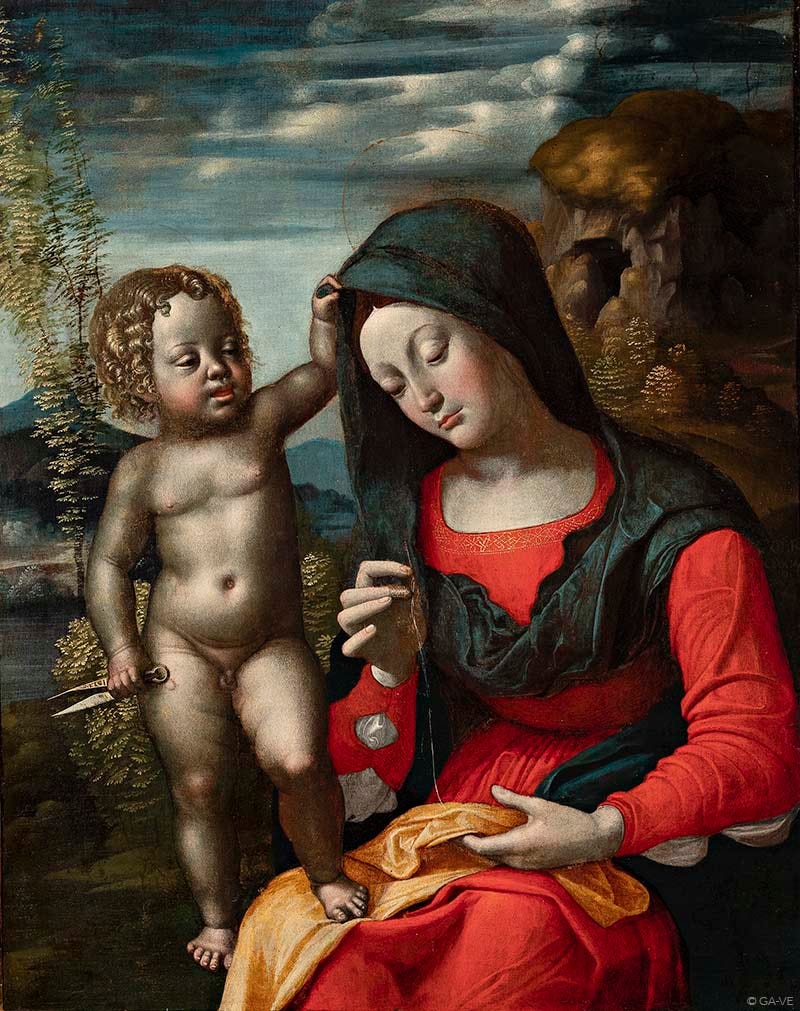
This isn’t really an ekphrastic poem, though my mental image of Mary sewing comes from somewhere I am sure. I’ve looked at so many medieval and renaissance paintings and illuminated manuscripts that there’s a lot jumbled in my head. I cannot pinpoint a specific painting that was in my mind, but there might have been one? (The picture I grabbed to illustrate this post is kind of wrong for an annunciation since it has baby Jesus in it. But I adore the scissors he’s holding, even if his skin tone is bizarre.)
I love images of Mary sewing or knitting in the garden. I have also previously explored images of Mary spinning and knitting and weaving in my ekphrastic poem Ave Maria on the Lake and in some other unpublished pieces. She would have spent a great deal of her life engaged in fiber arts of one kind or another as most women throughout history have.
I’m not sure where the snail came from— except that snails are a frequent theme in illuminated manuscripts. I love snails’ silvery trails and oh it makes me happy to compare them to metallic threads in the Virgin’s wedding veil. (I once had a favorite scarf that was white with silver threads.)
The image of Mary pricking her finger and the blood staining the veil is right out of Snow White and it’s such a happy rush how it just popped into the poem. I love fairy tales and twisting a fairy tale queen into Mary’s story feels so right.
origin story
This poem first came about as a misreading of a prompt. The Catholic Literary Arts Advent Poetry Contest had as its theme “Holy Silent Mother of God”. The first time I saw anything about the contest on Facebook all I saw was the title, no other information.
And I went on a little bit of a rant because I do NOT think of Mary as “Silent”.
I wrote furious notes (I think this was originally a text thread with my sister?):
It’s just... as I ponder it, I realize. I do NOT think of Mary as SILENT.
St Joseph is silent, but I always imagine Mary singing lullabies to Jesus.
She’s a poet. She sings the Magnificat.
In my imagination she’s almost NEVER silent.
She’s always singing.
Holy, silent
but not wholly silent
for she sings praise songs and she surely sang lullabies
just because her words are not recorded, rendered solid in the permanent record,
doesn’t mean she wasn’t speaking daily, all the usual words, the casual words, the important and earnest words.
Daily she prayed aloud and in the silent ponderings of her heart she sang the psalms and hymns of praise and thanksgiving and complaint and adoration, of supplication and lament
She greeted each new day with words of praise upon her lips and she greeted each night with thanksgiving
and in the silent hours of the night she woke to hold her crying son and whispered sweet words in his ears
oh her heart was full and overflowing with words and her son knew the sound of her voice from before the time he first drew breath
her strong spirit full of the Spirit’s grace greeted him and sustained him. Comforted and consoled him. To him she was not silent but the constant sound that first surrounded his whole world
his ears knew her voice before they knew his own
her voice laughing
her voice sorrowing
her voice grumbling and complaining
her voice calming
her voice rousing
her whispers
her cries
her exultations and lamentations
Surely that time in the Temple was not the only time he heard her voice chiding.
Later, after I’d written my rant and after I’d written the first draft of my poem, I saw a more complete contest announcement:
Sacred silence is a pathway to God. CLA invites you to take your own silence and meditate on God’s great love for you.
We encourage you to write a poem inspired by the sense of the sacred contained in silence. Then, submit your poem to the 2025 Advent Poetry Contest focused on the Blessed Virgin Mary as the Holy, Silent Mother of God.
Now this is a more reasonable prompt, take your own silence, meditate on God’s love for you. Write a poem inspired by the sense of the sacred contained in silence. If I’d seen this, more nuanced, prompt at first, I probably wouldn’t have ranted. And I might not have ended up with a poem. Certainly not with one about Mary singing.
As it was my first draft poem was too long for the contest’s guidelines. And Zina Gomez-Liss warned me that the judge is someone who prefers a strict formalism. So I decided my poem wasn’t a good fit for the contest— I have some mixed feelings about contests that require an entry fee anyway.
But I liked my poem. Except that even to my eyes the poem also had some major formal problems. I wasn’t quite happy with the way it looked.
This was a poem that came to me in several short rushes of rhyming lines that I jotted down on scraps of paper while I was going about my day. Like snatches songs. The problem was that they were all weirdly irregular. The first stanza had an aabb rhyme. Then a stanza with a ccccd. Then a stanza where each line had an internal rhyme but the lines didn’t rhyme with each other. Then a stanza with four of the same rhyme, three of them at the ends of the first second and fourth lines and one in the middle of the third line. And then that rhyme repeated again twice in the next stanza at the ends of the first and third lines, but with no rhymes in the other lines. Then two more stanzas with an aabb rhyme, another weird stanza with only two lines that rhyme, and a final aabb stanza.
I liked the feel and sound of the poem as it was. I didn’t think I really want to change it. But I also knew it didn’t quite work because the weird irregular rhymes would throw off a reader, leading them to expect regularity and then be irritated by the jaggedness. So I asked my friend Kate Bluett for advice since she regularly works in very neat forms and has a very good ear.
Kate generously said that she liked my poem too. Her super helpful suggestion was that it was the look of regular stanzas and line lengths (quatrains, with roughly ten-syllable lines) that made her expect a regular rhyme scheme. So, if I varied the line lengths and buried the rhymes, then they could come as pleasant surprises when they happen instead of jarring when they didn’t happen.
That was brilliant. But would it work? Only way to find out is to start tinkering.
So I reformatted the poem into a big fat paragraph, getting rid of all line breaks and stanzas. Then I just very quickly and intuitively broke that paragraph into lines that were relatively even but not ten syllables. I tried to go for line breaks that made sense with the meanings of the words and that felt like they breathed right. And at every turn to deliberately hide my rhymes so that none of them are end rhymes.
I guess you could say I went looking for other meaningful words to end the lines on. I messed around with line breaks for a bit, trying a few different things here and there, but mostly I just went with my first gut impulses.
Basically, I did exactly what free verse’s critics accuse free verse poets of doing: writing prose and then putting in line breaks to make it look like a poem. (Though to be clear that’s not how I approach free verse at all. Every draft of a poem has line breaks, that’s how I know I’m writing a poem instead of prose. But with free verse I do tend to tinker and change line breaks as part of the revision process. Except when poems just come out right the first time and don’t want or need to have line breaks revised.)
I think even if I can’t explain my breaks, they aren’t random. It’s just that they are intuitive rather than following some kind of rational scheme. But I don’t want to overthink it. I think I like the way the breaks fall now. And if I read down the right margin, looking at just my end words, they feel right.
I ended up with 52 lines. (Now it’s ridiculously over the contest’s limit of 32 lines.) It’s a nice number, like a deck of cards. I first broke them into four stanzas of 13. Those felt too unwieldy. So then I broke each of the thirteens into three tercets and a quatrain. This gives the poem a regular look on the page, which I find pleasing. But the lines are not metrically regular at all, rather they are pulling against the meter in which they first came to me. I hope that tension works.
I hope the form is helpful to the reader. Please let me know what you think. Does it work for you?
Melanie, I love this. It is beautiful in rich imagery and song. All the internal rhymes make it sing, and it's remarkable how uniform and intentional it looks after being pulled apart and put back together like you describe. I thought the three, three line stanzas were to represent the Trinity. The four line stanza in my mind made a kind of Sabbath because I thought of it as three plus four equals seven. I was marveling at how you could keep that up while making it look and sound so right. It all fit without being forced. I adore the fairy tale elements! I wondered initially if there was some legend about Mary pricking her finger that I had never heard before. The snail adds to the princess motif. Anytime an animal works on behalf of a maiden it elevates the story into a fairytale landscape. I felt like I could interact with this most familiar story and see it reenchanted. This goes in my commonplace.
I think this works so well! Reading it in this form, there were shades and nuances that leapt out, that I hadn't caught before. I think the lines have space to expand and breathe now, with the rhymes woven (sewn?) through the lines, instead of placed at the ends. Well done!