
November Reading Notes
Mostly Ursula LeGuin because evidently this has been the year of LeGuin


The Dispossessed: An Ambiguous Utopia by Ursula LeGuin
I listened to the audiobook of this one. It’s a classic work of science fiction and a masterpiece. I’ve been meaning to read it for a long time because it’s one of my friend Kyra’s favorite books. (Fun fact, somehow I have a paperback copy of it in French with a wild shiny silver cover. But I never read more than the first couple of pages in French.)
Imagine a completely anarchist, communitarian society with no private property founded on the writings of someone other than Karl Marx. Instead, imagine a female visionary named Odo who doesn’t have the Marxist ideas about history and the inevitability of class warfare. Imagine the Odo-followers, Odonians, exiling themselves to the moon and cutting off contact with Earth.
Now imagine an odd boy who doesn’t quite fit in socially who is growing up in that experimental anarchist/communitarian society with a brain that is highly gifted in physics and that sees the world and everything in it outside the box. Imagine him then getting frustrated by his society’s limitations which make it hard for people to appreciate the pure theoretical sciences. Imagine that while still completely believing in communitarianism he decides to go to earth to be able to connect with the community of scientists there. And then you have a fish out of water story as he tries to live and work in a hierarchical, capitalist society.
This summary completely fails to capture the weirdness and the genius of this story. It also it fails to convey what a charming story it is, how lovable and real the characters are, especially Shevek and his beloved life partner Takver. Because this is only partly a novel of ideas. That’s the framework, but really it’s a story about the people who live in the worlds that are shaped by ideas. It’s about the push and pull between idealism and real life, between vocation and duty, between individual needs and community needs, between life and love and work.
First of all, the moon in this story isn’t isn’t our Moon, it’s a planet called Anarres. And the earth isn’t our Earth, it’s a planet called Urras. They are some other Earth-Moon dyad in some other solar system. (Tau Ceti to be precise.) This isn’t clear at first, but eventually I figured it out.
By placing her anarchist experimenters within a completely different history and setting, LeGuin gives herself a large sandbox to experiment in. She can play with human nature but doesn’t have the baggage of actual human history to contend with. It allows for a different kind of thought experiment than a future history or alt history does.
The chapters move back and forth in time. The odd chapters take place in the present, with Shevek journeying in the country of A-Lo on the sister planet Urras. While the even chapters are flashbacks to his early life on his home world of Anarres, gradually moving forward to his decision to leave. This works really well as a structure, the story starting in the middle and gradually filling in the pieces of the past as it moves forward. It means that the reader starts off like Shevek plopped into a strange world, understanding nothing. And at the same time we also stand in the place of the people of Urras, not really understanding Shevek any more than his hosts do. The structure, the way the novel unspools, is really lovely.
LeGuin’s Anarres utopia is ambiguous because it is very human and very flawed and works about as well as all human systems do. People are people. They are both lazy and hard working, both corrupt and honest, both selfish and selfless, and all the possible permutations of good and bad characteristics. There are idealists and realists and mostly a lot of people just trying to get through the day, one foot in front of the other. LeGuin’s bedrock acceptance of the realities of human nature allows the novel a freedom to explore both the strengths and weaknesses of Odonianism without needing to didactically prove or disprove it as a viable system of thought. And this is why the book is such a masterpiece and rises above the usual fare of utopianism or dystopianism. Anarres is a human society, far from perfect, but also far from horror-show. LeGuin is interested in ideas, that is clear; but she’s even more interested in people.
Shevek is flawed. He comes across as autistic-coded. He’s not always great at relationships and he has some kinds of rigidity in his thinking. (To be clear as I find this endearing because neurodivergent is my tribe.) But he’s not terrible at relationships either. In a way you can see where the anarchic Anarres society is actually pretty kind to neurodivergent people. There’s a kind of flexibility and acceptance of people as they are without a need to mold them in certain utilitarian ways. I really like the chapters about Shevek’s education. There are some interesting things to ponder. Again, it’s not perfect, but it’s different.
Shevek’s also a bit dumb about politics. He doesn’t quite fit in because he’s not good a picking up on social cues. But he’s not a complete loner loser either. He is a genius when it comes to theoretical physics, but it feels like a normal human talent, not like some kind of over-powered wish-fulfillment.
His partner, Takver, is an artist and a biologist and they have a good life together. They work well together, love their kids, make sacrifices for their family, endure long but necessary periods of absence from each other while staying faithful to each other. One of my favorite parts of the novel is their love story. It’s a beautiful human relationship.
I like that LeGuin’s utopian society has room for men and women to choose to have life-long pair bonds and raise children together, even if it’s a little counter-cultural within the anarchic Anarres society. She recognizes that fidelity is a human good and that many people yearn for a live out a life-long pair-bonding, even though some people do not seem to want it or care about it at all. This feels incredibly counter-cultural for the early 1970s.
I don’t have much to say about the political philosophy and socialism. It’s not the most interesting part of the book. I think I might pay more attention to the ideas in a future re-read. For this read I really just fell in love with the people.
There are some amazingly beautiful passages in the novel, but since I listened to an audiobook, I can’t find and quote them. I’m definitely going to have to re-read this book with an actual text copy that I can mark up.
Between the World and Me by Ta-Nehisi Coates
A memoir in the form of a letter to his son, also a meditation on what it means to be a black man in the United States. The title comes from a Richard Wright poem of the same name that is about finding the skull of a lynched man in the woods and being possessed by the dead man and experiencing his death. Likewise Coate’s memoir builds to the murder of his college friend. This is a death-haunted book.
I listened to the audiobook, read by the author. It’s not very long and it’s quite powerful.
I picked it up because I watched an interview with Coates on Trevor Noah’s podcast. They were talking about a different one of Coates’ books, his most recent publication, The Message; but it got me curious and well one thing led to another. As for why Trevor Noah’s podcast, it might have something to do with having spotted him at the airport in Rome this summer. I liked Noah’s book Born a Crime when I read it a few years ago and I find him an interesting person to listen to.
Coates is a good storyteller and I found myself caught up in his life story. He is working out ideas about race and racial violence within the framework of his own life story. He’s an atheist and his worldview is radically different from mine. And yet he makes me feel great understanding and sympathy for the ground on which he stands and for the reasons he sees the world the way he does. He is thoughtful. He is rooted. He’s questioning and open to experience and to ideas. I appreciated the journey his book brings me on, seeing the world through his eyes, walking in his shoes. How can we bring peace to the world if we are unwilling to listen to the pain and heartbreaks and joys and loves of our neighbors? This book is a gift of self to the world.
Monk’s Hood: A Brother Cadfael Mystery by Ellis Peters
The third book in the Brother Cadfael mystery series. In this book Cadfael finds himself meeting the woman who he was once engaged to be married to in the long ago time when he was young. But he went off to war and took his time coming back and she married someone else. She’s the widow whose husband’s death (he’s her second husband) is the mystery Cadfael is trying to solve. The widow’s son by her first husband is the accused and Cadfael must clear his name.
I didn’t find this one quite as engaging as the first two in the series, but I did enjoy it. I don’t think it was a fault of the book at all, perhaps it was maybe not quite what I was in the mood for. Not quite the right book at the right time. Sometimes such mis-matches happen and it’s not the book’s fault.
Annals of the Western Shore trilogy (Gifts, Voices, and Powers) by Ursula LeGuin
Three young adult novels all set in the same world, with the protagonists from the first book appearing as minor characters in the second book and at the very end of the third book. These books all explore in some way characters who have some kind of supernatural power or gift and their wrestling with what their gifts mean to their lives and with the moral implications of their gifts. These novels were published when LeGuin was in her seventies and are the work of a master craftsman. All of them are appropriate for teens. There are some non-graphic references to sexual violence and rape; but they are not books that explore sexual relationships in detail that would be problematic for young readers.
All three books are very interested in literacy, storytelling, and poetry and the development of the mind and of how stories and poetry create cultures and connect people.
Gifts
A young boy, Orrec, and his best friend, Gry, are both inheritors of powers that run in families. They live in the remote mountain highlands where all the clans are ruled by clan chiefs called brantors who have such powers. Each clan has a power that is unique to their clan and these gifts have a clear genetic link. Once a generation or so the gift will manifest strongly and that person will become the next brantor of their clan.
The gifts are by and large cruel and monstrous and are used to hurt and dominate other people, both within the brantor’s clan and in other clans. All of the clans exist in a state of warfare and skirmishing with constant cattle raiding and slave taking. All of them are trying to gain the upper hand or to survive. Most of the land is poor and most of them live a pretty hand to mouth existence at barely greater than subsistence level agriculture with starvation one bad harvest away and almost all of them are illiterate.
Orrec’s mother was a lowlander woman whom his father brought back from a raid. She taught Orrec and Gry how to read and write and introduced them to the stories of her homeland. The power of her stories changes their hearts, giving them a vision of a different kind of life. Orrec eventually becomes a poet and storyteller himself. The book’s initial frame involves him telling stories about their powers and way of life to a skeptical lowlander man who has stumbled onto their farm and who does not believe in their magical powers.
Orrec’s family’s power is the ability to unbind or unknot with the power of the mind. This includes the simple parlor trick of untying a knot, but it can also be used to dissolve the bones of a living thing, killing it instantly. Orrec is terrified of this gift and does not want to inherit it or to learn how to use it. Mysteriously, Orrec’s father has “sealed his eyes” to prevent him from using his gift. It takes a long time for the story to reveal all the ins and outs of this decision and its implications. It’s the central problem of the story. Meanwhile, Gry has inherited her mother’s ability to communicate with animals, which her mother uses to summon animals for the hunters to kill them. Soft-hearted Gry does not want to use her gift in that manner.
Gifts is a coming of age story about both Orrec and Gry coming to terms with who they are in their powers, in their families and society at large, and to each other.
Voices
Set in the same world as Gifts, Voices takes place in a lowland city far to the south of the Highlands setting of Gifts. Different culture, different understanding of magical gifts, but they do speak a common language and have a common ancestry.
Mermer is a teenaged girl in the city of Ansul, which has been ruled by invaders her whole life. She is, in fact, the child of one of the invading Ald soldiers who raped her mother. She lives in a ruined palace, Oracle House, which is also the home of the Waylord, who is a mysterious scholar and head of the household. At first Mermer seems to be merely a servant girl, except as the story progresses she is revealed to be more than a servant. She is also a daughter of the house, a descendant of the family who has lived there— her exact kinship with the Waylord is never really explained. And as a daughter of the house, she is responsible for the daily worship at all the many altars of the household gods.
The Waylord is a crippled man, tortured by the monotheistic desert-dwelling invaders who fear the native religion of the local peoples, calling their pantheon of gods demons. The invaders have come on a kind of holy crusade, believing they have a mission to crush the demonic powers. Mermer and her household are surviving in an occupied city, oppressed by the Alds, clinging to their culture and their gods, but necessarily doing so in secret and always afraid of reprisals.
There is a secret room in Oracle house that only Mermer has access to. It is filled with books and mysteries. One day she meets the Waylord in the room and he decides to teach her how to read the books. She becomes a scholar. The Ald invaders are book burners and so this is a dangerous occupation indeed.
And then Orrec and Gry appear. Orrec is now a wandering storyteller and he and Gry are married. (Gry also has a pet lion.) Mermer brings them to Oracle House and the Waylord takes them in. They are invited by the Ald ruler to come to tell him stories. And Mermer comes too and starts to wrestle with the humanity of the Ald overlords. And thus begins a complicated story of political turmoil by stories and songs, with Orrec and Gry caught in the middle between the two peoples, Alds and Ansuls. There are those who only want violent uprisings, while the Waylord seems to have a more subtle aim towards a thorny kind of peace and the difficult rebalancing of power between oppressed and oppressors. The story shuns simplistic binaries and instead depicts a realistic web of complicated relationships and inequalities that must be negotiated with Orrec, Mermer and the Waylord as different kinds of bridge-builders.
And then of course there must be a power or gift. As it turns out Oracle house does have a gift and of course it has to do with the oracle of its name. And with the books. Mermer must learn to negotiate with the mysterious oracular voices. And oracles are always difficult to interpret.
Voices is so very different from Gifts, but it is also a kind of coming of age story. I loved it so much, the characters, the cultures, the way the story builds and unfolds. It’s masterful.
Powers
Gavir, the protagonist of Powers is a slave, captured with his sister, Sallo, as a child. He has no memory of his people, but he does know that he was born in freedom. However he has been completely socialized as a slave and does not at first perceive the injustices of slavery.
Gavir grows up in a large, rich household in the one of the central cities, Etra, a warlike city whose economy relies on slaves taken in war. (Reminds me of ancient Greek or Italian city-states.) He is an educated house slave who is being raised to eventually become the tutor for the household’s children. He refers to the heads of the family, the House of Arca, as the Mother and the Father— they are benevolent slave owners who for the most part treat their slaves well. The Mother nurses sick slaves with her own hands. Gav perceives the Father as a stern but benevolent patriarch. But of course it’s still slavery and from the beginning the narrative allows us to see past Gav’s point of view to the profound injustices. As the story unfolds he gradually becomes more and more aware of them himself.
From the first line we are aware that Gav has a power: he sometimes has visions of the future that come true. Sallo warns him not to tell anyone about them. The masters, the Etrians, are afraid of such powers. They must not know.
The story begins in the schoolroom where a handful of slave children are being educated, learning to read and write alongside the children of the Arca family. In addition to his power of seeing the future, Gav also has an eidetic memory and can recall perfectly everything he’s read. He loves books and learning, even though the household’s library only contains a handful of ancient classics. The slave-tutor, Everra, disapproves of new books. He is thoroughly socialized as a slave and tries to teach Gav that their slavery is a good, part of a social order that must not be questioned but accepted uncritically.
And it is clear from the beginning that there is a clear distinction made between the slave children and the children of the House. And yet there are true friendships there and indeed a kind of love. There are idyllic summers in the country where the children play together, build a city, recreating the fortress in one of their favorite epic histories. But of course childhood idylls end with coming of age and learning about the harsh realities of the world. In this case, war and famine. During a siege Gav is sent out to work in the city with other slaves, doing backbreaking labor on short rations, and for the first time experiences the harsher side of slavery.
And then Sallo is given as a concubine to the oldest son of the House. They are childhood sweethearts and although it is a fundamentally asymmetrical relationship, he loves him and he loves her. You know it won’t be enough. He will eventually be married off to a rich woman. But Sallo believes she is blissfully happy. And then the older son goes off to war and his jealous younger brother takes his revenge on Sallo and she is killed.
Gav doesn’t intend to run away, but in his grief at his sister’s death he dissociates and wanders off, hoping that the family will think that he drowned himself. Then begin a long series of adventures as a runaway slave. He encounters a few different societies of runaway slaves living in the woods. He eventually finds his way back to his own people and tries to integrate into their society but finds that he doesn’t fit.
Because of Gav’s gift you know that he is heading to an encounter with a particular man. Because of the shape of the series, you guess and hope that it is Orrec and that eventually Gav will find his place in the community that Orrec and Gry and Mermer have created of scholar/poets/storytellers in a university town in a city where there are no slaves. But Gav’s journey is the story. Once again, it’s a coming of age story. But it is also, like the others, a story that explores the theme of power. Not just the power of magical gifts, but the powers of strong men to oppress weak men.
LeGuin’s particular gift is in creating and exploring not just characters but societies. She is curious about how history, poetry, folklore, and story shape culture. She’s interested in how human beings work not just as individuals but as social beings. Her father was an anthropologist and cultural anthropology informs her world building and her story telling. In Powers she is at the height of her power as an author. It is one of her finest books. I can’t believe this trilogy isn’t better known and more talked about. Is it overlooked because it is juvenile fiction? Or because it resists neat categories?
They aren’t easy stories. They aren’t rip-roaring fun adventures. The pacing is slow and deliberate at times. They take their time. They are deep and profound and true. But they aren’t grim-dark either. There is so much hope and joy and love for poetry and story in these works, so much love of people in their flawed, glorious humanity. LeGuin is a taoist and a feminist and thus her worldview is most definitely not mine. And yet I don’t care because she is a truth seeker, and her insights into the human condition are true and profound. She loves people, she understands people and in the end that is much more profound a connection than her personal belief system. Her books are worth reading because they do what William Faulkner says is the writer’s task, to explore “the problems of the human heart in conflict with itself which alone can make good writing because only that is worth writing about, worth the agony and the sweat.” LeGuin, like Faulkner, writes about “the old verities and truths of the heart, the old universal truths lacking which any story is ephemeral and doomed – love and honor and pity and pride and compassion and sacrifice.” And she writes them very well indeed.
What books have you been reading, dear reader?
I always had a secret wish that Brother Cadfael was a REAL person. 😊 lovely list for November! Thank you!!
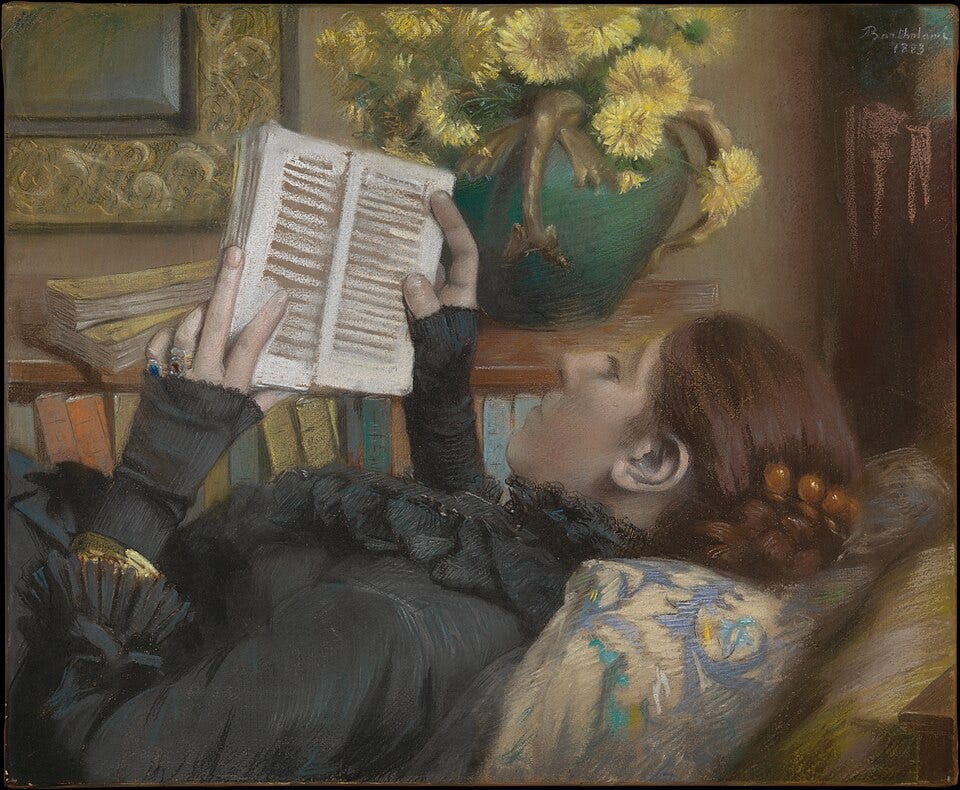
The painting you chose is amazing. I am so used to seeing paintings of people reading in rigid, rather uncomfortable positions. This woman looks comfortable and engrossed in her book. She isn’t putting it down when the tea comes, she might shift position slightly, but that is it.