
March Reading
a partial survey of what I read last month

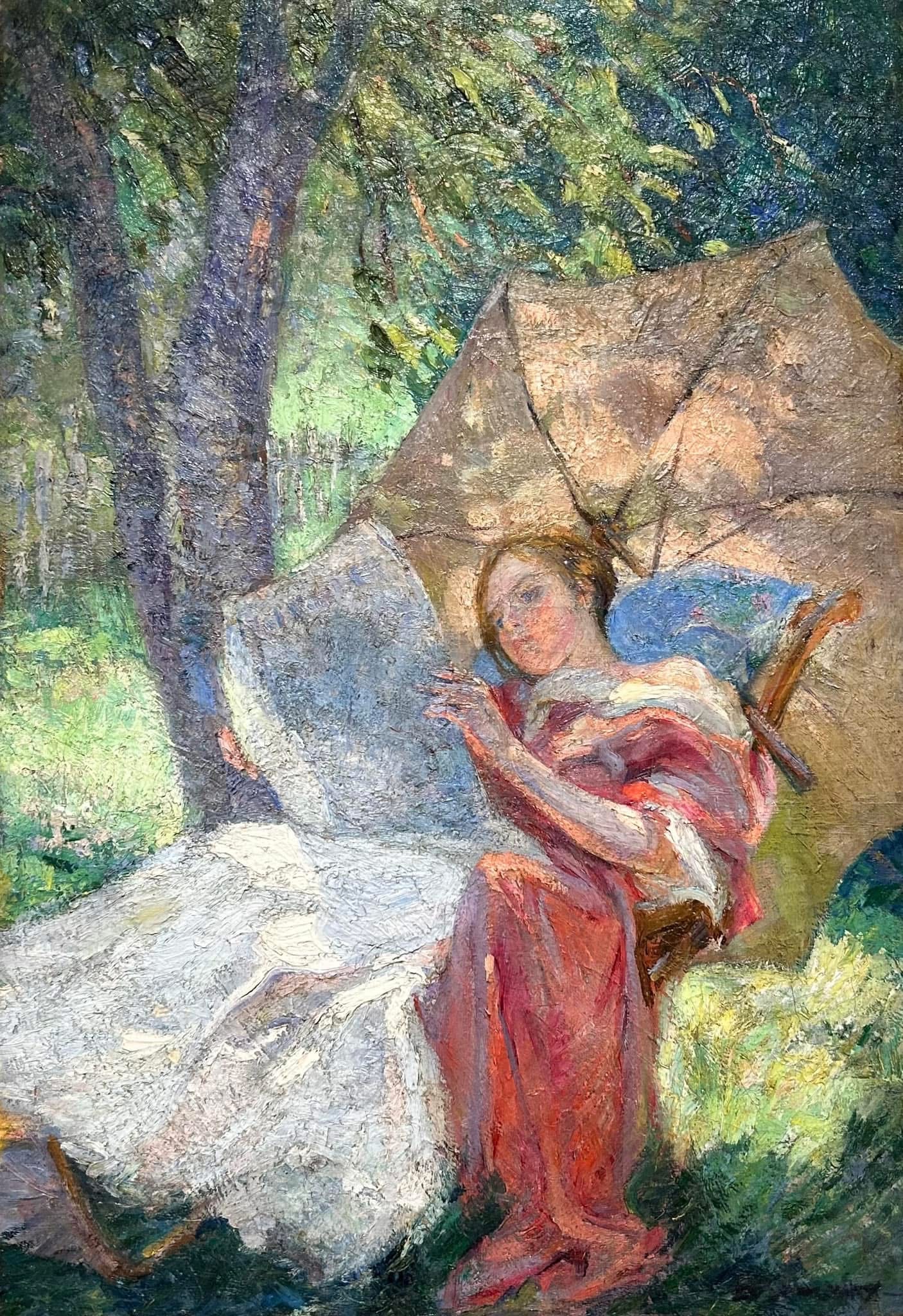
It seems my trend for this year is slow reading. Once again I’ve finished exactly one novel. I’ve started several more, and am reading slowly through quite a few books of poetry.
Now that I think about it, perhaps I’m reading less because my eyesight is getting worse. In the past few years I’ve developed diplopia and reading is harder. Is my distractibility while reading about being addicted to my phone, or is it really about my eyes getting fatigued and needing a rest?
But also, I’m feeling drained, squeezed-out, and brain-foggy. Nothing quite seems in focus these days and I always have more on my plate than I can handle. I’m trying to accept the season for what it is and just enjoy the fruits such as they are.
FICTION
The Scent of Water by Elizabeth Goudge
Jean was visited by one of her rare moments of happiness, one of those moments when the goodness of God was so real to her that it was like a taste and scent; the rough strong taste of honey in the comb and the scent of water. Her thoughts of God had a homeliness that at times seemed shocking, in spite of their power, which could rescue her from terror or evil with an ease that astonished her.
This was a re-read for me. I felt I very much needed to spend time with Goudge this Lent and The Scent of Water was a perfect choice.
The protagonist, Mary Lindsay, thinks she has her retirement mapped out. She’s going to live in London with a friend “where they would have music, ballet, and good plays, all those things.” . And then a cousin dies and leaves her, The Laurels, a house in the country village of Appleshaw. And suddenly remembering her single and singular long-ago encounter with her father’s cousin, she gives up all her plans to move into that house.
“This may be my last chance to live it.”
“What?”
“Country life. I’ve never known it. I’f like to before it and I disappear from the English scene.”
Her deceased cousin, also called Mary Lindsay and in the book always referred to as Cousin Mary or Miss Lindsay, was a woman that Mary had met only once, when she visited the cottage as a little girl. The two Marys felt an instant connection, but Mary was never brought to visit again.
When she moves into the cottage Mary becomes part of a small village community, and becomes enmeshed in the small local dramas and relationships: with Mrs Baker who had been paid by Cousin Mary to help her for a few hours a week but who spent much more time with her and who loved her, with the blind novelist Paul and his wife Valerie who has become emotionally estranged; with the children next door and especially with the adopted oldest girl, Edith, who doesn’t seem to fit in anywhere but who has a connection with Mary’s house and with the “little things”, a collection of miniatures which also enchanted Mary when she was a girl; with the vicar’s sister, Jean, who is most certainly neurodivergent, clumsy and afraid but who has a beautiful soul which blossoms under Mary’s loving care; with the elderly and frail Colonel and Mrs Adams whose wastrel son squanders all their savings.
Mary gets to know her cousin through reading her diaries but also through talking to the people who knew her and cared for her. Cousin Mary had a mental illness all her life but also a deep spiritual life and she found healing living at the Laurels, which she discovers used to be the infirmary of a long-ago monastery.
The scent of water, of the rain and of the dew. It was difficult to separate it from the grateful fragrance of the life it renewed, but it had its scent; the faint exhalation of its goodness. It would still come down upon the earth after man, destroying himself, had destroyed also the leaves and the grass. Its goodness might even renew again the face of the burnt and blasted earth. He did not know. But unlike Job’s comforters he believed there was a supreme goodness that could renew his own soul beyond this wasting sorrow of human life and death.
The Scent of Water is a story about healing and community. Almost all of the characters have wounds— many of them that can be traced back to the Second World War. Mary lost her fiancé, John and her coming to the Laurels becomes a time where she finally feels free to grieve him. The closer she comes to her deceased Cousin Mary, the closer she comes to John as well and she comes to love him more as she comes to love her neighbors in Appleshaw.
“My dear,” he said, “love, your God, is a trinity. There are three necessary prayers and they have three words each. They are these, ‘Lord have mercy. Thee I adore. Into Thy hands.’ Not difficult to remember. If in times of distress you hold to these you will do well.”
The Axe by Sigrid Undset (Olav Audunsson/The Master of Hestviken Book I)
Olav Audunsson is a four-volume work by Norwegian novelist Sigrid Undset. I have read Kristin Lavransdattar, her other multi-volume medieval masterpiece, twice now and her modern two-part novel The Wild Orchid/The Burning Bush as well as her biography of Catherine of Siena and many of her essays.
I’m reading the older translation, which was called The Master of Hestviken, because that’s the copy I have. The newer translation retains Undset’s original titles. I imagine at some point in the future I might pick up the newer translation for a re-read.
My plan is to read slowly—right now I’m managing about two or three pages a day. I’m about halfway through Volume I, The Axe/Vows. This feels like the right pacing. Undset’s medieval Norway is already familiar to me from Kristin, but even so the story starts slowly. It was good to begin to read it while also reading The Scent of Water— much easier for me to be patient with a slow start when I’m reading another book that moves forward at a slightly faster pace and is easier to read. (Not that Scent of Water is at all a quick-moving book!) But as I go on I imagine I might pick up the pace and make Olav my primary fiction focus.
The Interpreter of Maladies by Jhumpa Lahiri
I read the first four or five stories in this short story collection before it went back to the library. Jhumpa Lahiri is Indian-American (though she is currently living in Italy and writing in Italian) and most of the stories are about Indian-American characters living in the Boston area. Some of them are about people in India or as in the title story, about Indian-Americans visiting India. The stories I read were mostly about broken relationships, infidelity, and heartache and missed connections. Good stories, but not very uplifting. I will check out the collection again in the future to finish the stories and see if any of them are more hopeful. I don’t have much to say about the ones I read. I’m still processing them. But in tone they reminded me a lot of some of Claire Keegan’s short stories.
Maame by Jessica George
A novel about a young woman living in London. Her parents are from Ghana and her absentee mother spends every other year in Ghana. Meanwhile the protagonist works at a job that she doesn’t love and is caregiver to her father who has Parkinson’s. I’m not very far into it.
I picked it up on a recommendation by Chantel Grant of Always Be Reading. (I have very much been enjoying her You Tube chats with Stefani Roth about Octavia Butler’s Parable of the Sower and Parable of the Talents.)

This Is Happiness by Niall Williams
My current audiobook, This Is Happiness returns to the small Irish village of Faha in County Clare in which The History of the Rain and The Time of the Child are also set. An elderly man remembers the past, narrating about the time the rain stopped when he was a youth, linking it to the coming of electricity to the town of Faha. Appropriately, the main action so far has been taking place over Good Friday to Easter Sunday.


POETRY
No One Ever Says by Mary Katherine Creel
I finally finished my first pass through this beautiful collection. I am sure I will read it again and again. I had already come to love MK’s nature poems on her substack, a small spectacle. They are delicate and deep and always a refreshing like a cool draught of water. Seeing them collected here, though, I find myself reading them differently, drawn into a story of grief and a dialogue with nature that is healing. These poems feel intimate, confidential, and vulnerable. They are at the same time strong and fragile.
After Prayer by Malcolm Guite
The first section of this collection is a sequence of sonnets that meditate on George Herbert’s sonnet, ‘Prayer’, each of Guite’s sonnets takes for its title on phrase in Herbert’s sonnet. (click through the link to see how Guite has delightfully arranged his poems as hypertext to Herbert’s poem. Also to hear Guite read Herbert’s ‘Prayer’.)
I’ve been reading these during my Wednesday night holy hours, a few poems at a time. So lovely.
What He Did in Solitary by Amit Majmudar
This is a library book, so I’m trying to read through more quickly. I’ve been reading it while waiting during my kids’ karate lessons. Witty, often pointed, sometimes heartbreaking. I love Majmudar’s word play. An anesthesiologist, he often plays with medical terminology and those poems often hit a sweet spot for me.
My favorite poems so far from the first section of the book are:
‘Chillicothe Apostrophe’, an ode to Ohio':
“Here’s my odi-et-amo                 Ode to you, O
homely Ohio                                  of the torn-up turnpike,”
‘Cat’s Cradle’, a love poem that uses the string game of cat’s cradle as an extended metaphor for a romantic relationship. The form in this one delightfully mimics the form of a cat’s cradle:
"               The cat
        in my creche
is your name

         on my breath. To love
is to be bound
          like this and freed

like this.
‘Neurology of Pain’ a three part poem:
Asterognosis, [a loss of the ability to recognize objects by handling them]
"He places his hand in hers,
but she doesn’t recognize it. What was love once
is beyond forgotten now, is never having known
at all. "
Apophenia, [the perception of patterns and connections where none exist]
"Their minds were rhymes. But rhymes can rhyme by chance.
A rhythm, too, can hear itself where there's
really nothing but the rain's spondees"
3. Prosopagnosia, [the inability to recognize faces]
" The ancient tragedies
are always ending with anagnoorisis,
the recognition scene, in which the lover
proves to be the one person
the oracle warned you never to love.
might this estrangement be
the least unhappy ending?"
‘Rate Your Pain’, a list poem, riffing on the kind of comparative pain scale that doctors use to try to assess patients’ pain; but in this case the numbers and their descriptions tell a story, the dramatic progression of an ailment and relationships in the life of a singular, though unnamed person:
3) Sharp, but only in certain easily avoided positions. Unexpected recurrence during afternoon racquetball game. Controlled with over-the-counter nonsteroidals already in medicine cabinet but close to expiration. First passing reference in conversation with spouse.
Under the Terebinth by Anna Friedrich
This one just came in the mail and I haven’t had time to read more than a couple of poems. I love Anna A. Friedrich’s Substack, Monafolkspeak, and especially the series she’s currently working on, An Overness, exploring the idea of God being over, above, up, on high— which was an idea that we discussed with our tour guide, Lorella, this past summer in Italy.
MAILBAG
Is there anything in the world better than getting poetry in the mail?
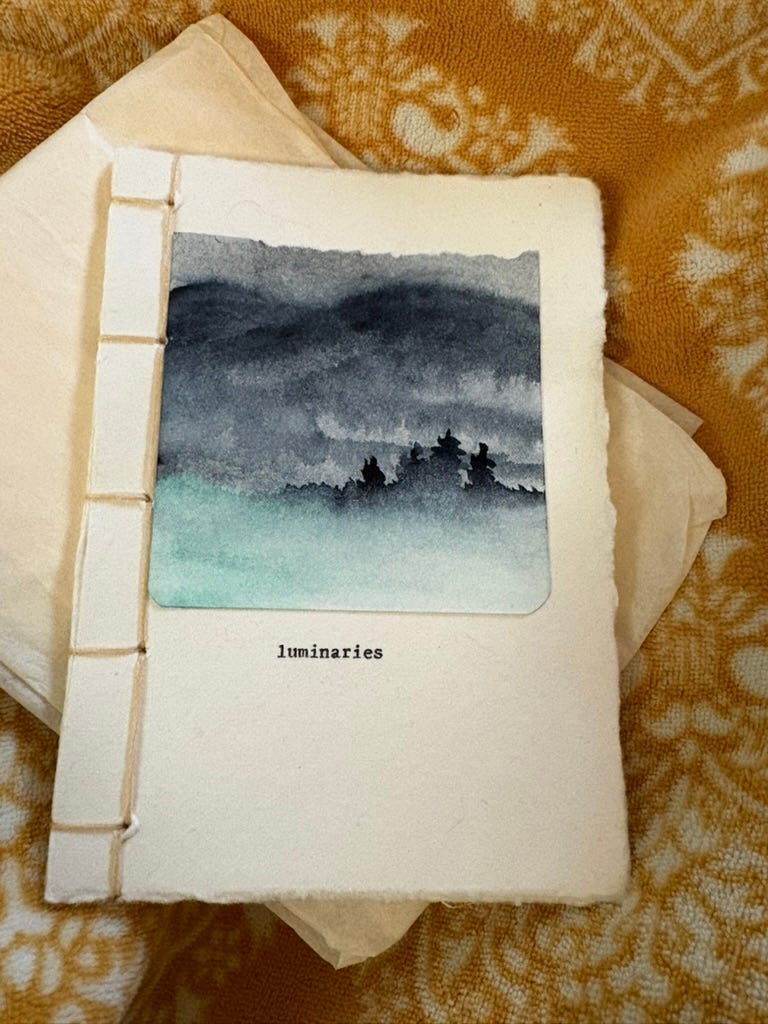
Luminaries, MK Creel’s beautiful handmade volume of poems, offered as a limited run. Everything about this book is enchanting, the lovely thick paper, the original watercolor. And the poems are delicate and precise. My 13 year old daughter and I took turns reading them to each other one afternoon. A feast for the heart.
It makes me want to make my own little collections of poems.
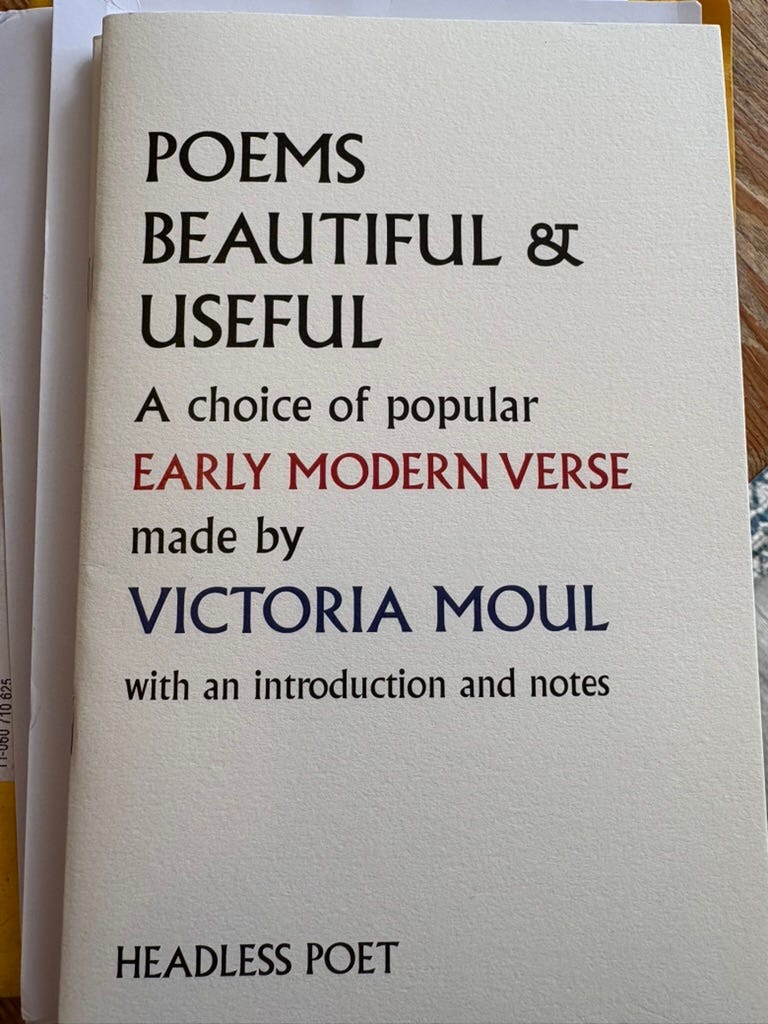
A lovely collection edited and with notes by Victoria of Horace and Friends.
“In early modern England it was taken for granted that a good poem is both beautiful and useful: that it teaches or expresses something that is helpful to remember, as one tries to conduct a decent life. This pamphlet presents a selection of English poems from the sixteenth and seventeenth centuries which are, in most cases, not well known today. The poems have been chosen to reflect the kinds of verse that were most popular with readers at the time, but also for their beauty and utility.”
A collection of poems I’m savoring slowly. I like that it is small, easy to slide into a purse or large pocket, that the poems are selected with thoughtful care. I want to read older poems as well as newer ones and this collection is another reminder to do so.
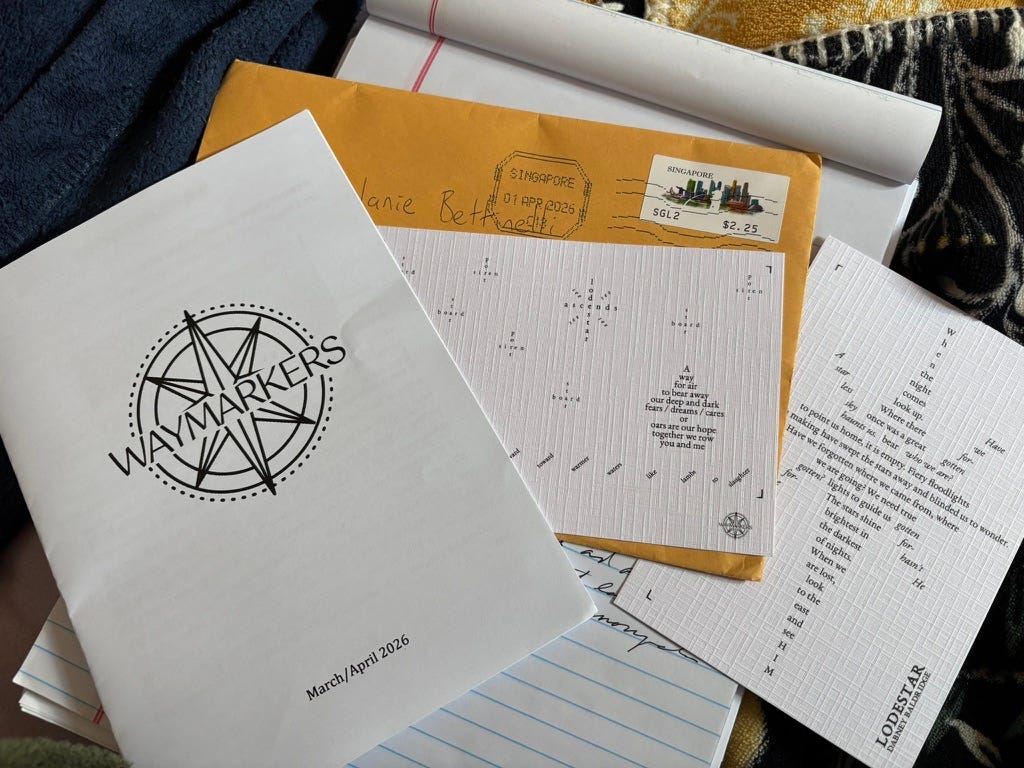
Two shape-poem postcards with poems from A. A. Kostas of Waymarkers and Dabney Baldridge and an essay that I haven’t read yet. But will in time.
Sometimes I like to savor my mail and hold off reading to prolong the anticipation. Do you ever do that?
(By the way, if you would like to receive original poetry in the mail, become a paid subscriber to Singing, each to each and I will periodically send you a poetry postcard or other goodies.)
Please chime in with comments about what you are reading. I really want to know —other people’s book lists are irresistible.
I read Scent of Water thanks to you. It was more moving and spiritually encouraging than I expected fiction to be. I teared up multiple times. The language is so beautiful. It absolutely won me over and I quickly put more Goudge on hold at the library. I don't understand how I had never read her before! Getting mail is the best and I savor it too. 💚
I think The Scent of Water might be my favourite book by Elizabeth Goudge. I have read it many times - most recently in 2024, according to Storygraph. I didn't get through many books in March either. I enjoyed the world building of the Teixcalaan duology by Arkady Martine (A Memory Called Empire and A Desolation Called Peace), but found them harder to read than they needed to be because she flips between perspectives too frequently. I also read The Astral Library by Kate Quinn - always a fan of fantasy involving libraries or archives! - but was a bit disappointed in it. Too much obvious moralising about the need to protect libraries. Not that I disagree with the sentiment, I would just have preferred a novel to be more subtle. Now I am into a re-read of The Lord of the Rings!