
Ekphrastic Challenge #3
Adoring the Light with Georges de La Tour

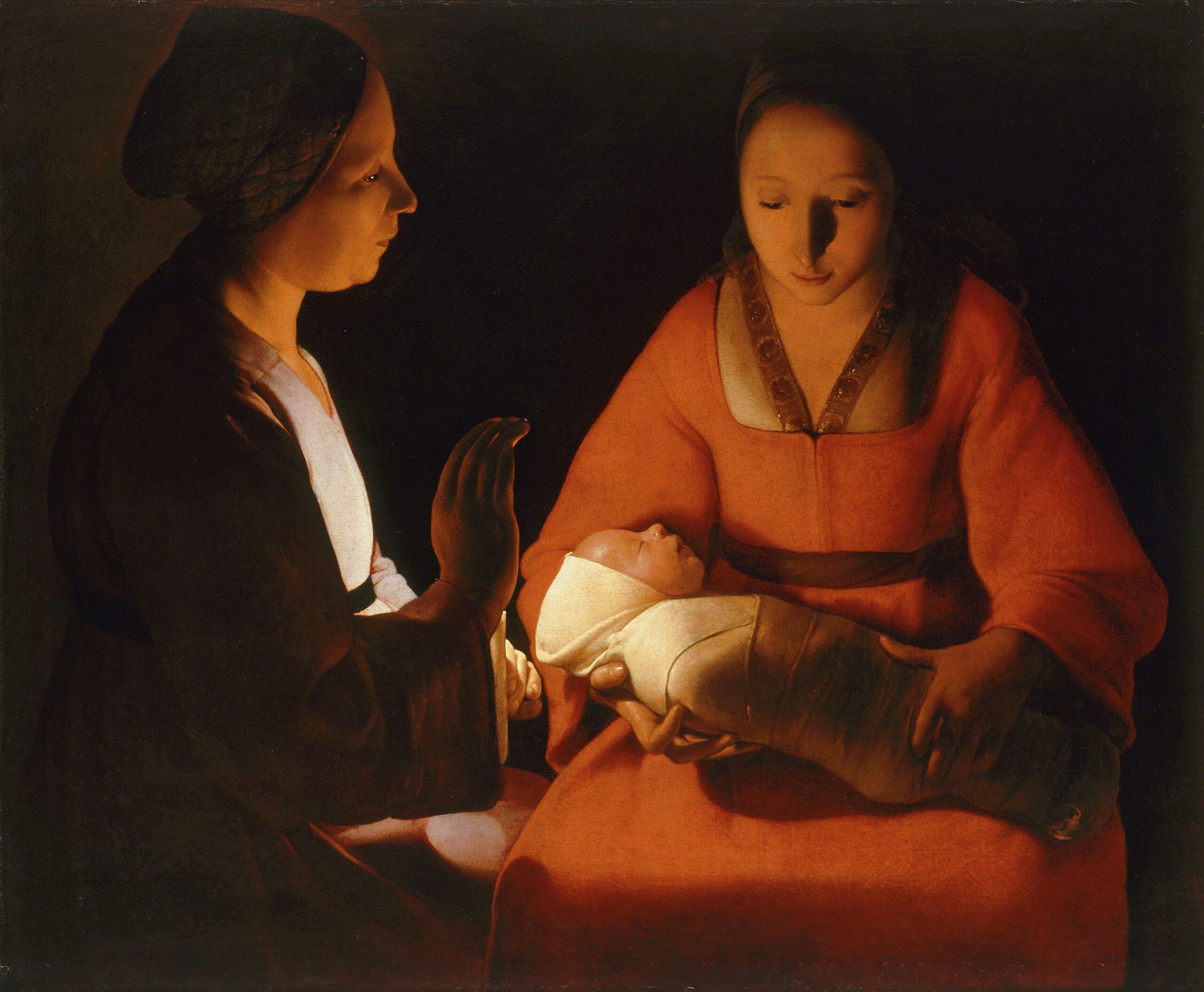

I first discovered Georges de La Tour when the Kimball Museum in Fort Worth had an exhibition of his work back in 1997. He’s been one of my favorite artists ever since.
I have a print of his Penitent Magdalene hanging on my bedroom wall. (I think I bought it at the National Gallery.) She sits with her chin in her hand, her elbow resting on a desk, staring into a candle, her hand resting on a skull. The candle is tucked behind the skull so that the skull is a dark shadow almost but not quite blocking the light— which makes the saint’s face and arm shine with glorious light.
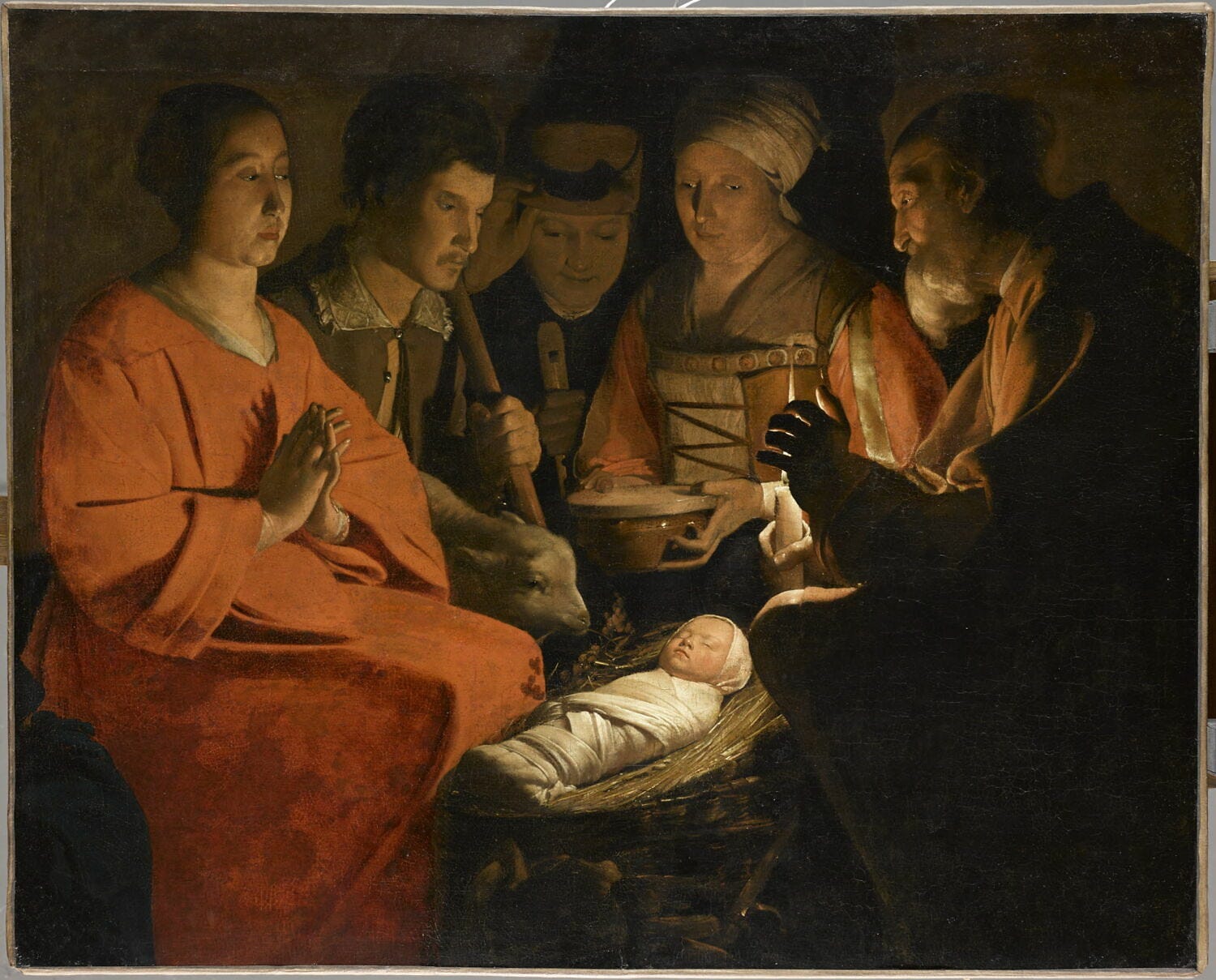
I was reminded of Georges de La Tour this morning when I read this beautiful ekphrastic essay in Plough Magazine: Can a Painting Save You? by Sean Rubin. In it Rubin highlights the role that de La Tour’s painting, the Adoration of the Shepherds, played in his mother’s conversion (or reversion, really).
The Adoration of the Shepherds is indeed a beautiful painting. And yet it doesn’t call to me in the same way as The Newborn Christ. The colors of Adoration are more muted, the baby’s face doesn’t have quite the same quality of milk-drunk open-mouth and sweet rounded chin that reminds me so much of my fourth child as a baby. And there is something about Mary’s face in Newborn Christ that I can’t stop looking at. And Saint Anne has this look in her eyes.
So it is The Newborn Christ I’ve chosen for this late-Advent ekphrastic challenge.
However, if you would prefer to write about The Adoration of the Shepherds or indeed another Georges de La Tour painting, by all means consider the challenge expanded. We are not sticklers for rules. (They’re mostly guidelines.)
Please share your poems in the comments below. Or post your poem on your own page and leave a link below or tag me in your post. I’ll be sure to collect them all in my follow-up post when I share my own poem. Or you can wait and share your poem when I post mine. There’s no wrong way to join in the challenge.
Even if you’ve never written a poem before, feel free to jump in.
And if you don’t feel up to a poem, you can still write a prose response.
And Now for a Rabbit Trail That Is Entirely Tangential to the Challenge
I’ve been following a bit of an odd de La Tour rabbit trail this afternoon and since it interested me I thought I’d share even though it might be a bit of a distraction from the ekphrastic challenge.
This 1996 Smithsonian article about the exhibition I saw, From Darkness Into Light: Rediscovering Georges De La Tour, drops this intriguing line with no further explanation:
It is one of the gnawing anomalies of art scholarship that Georges de La Tour was "lost" for nearly three centuries and yet with us all the time. His luminous paintings were on view in public and private spaces, wearing labels identifying them as the work of Murillo, or Velázquez or Caravaggio.
How was he “lost” and why? How was he rediscovered and by whom? How can you just drop that information like a bomb and walk away?
I had to go looking.
Wikipedia’s article on Georges de La Tour gave me another breadcrumb:
Recognised during his lifetime, he was quickly forgotten after his death. Rediscovered in the early 20th century by German art historian Hermann Voss,
So who was Hermann Voss? Well… he was the director of the Führermuseum from 1943 to1945, in charge of collecting art for Hitler— though his Nazi connections are not mentioned in the Georges de La Tour article. Now I think I’m starting to see why the Smithsonian didn’t offer an explanation. This is too big a story. And maybe they didn’t want to touch the Nazi question.
This New York Times article, La Tour in Paris:Of Light and Tragedy, has a bit more information. (I note that here there is also no mention of Voss’ Nazi connections, he is once more only referred to as“a German art historian”, which granted at the time he was doing this work he was not yet a Nazi as they had not yet risen to power, still it is a silence.)
Academe rarely operates at lightning speed. It was not until 1915 that a German art historian, Hermann Voss, projected a visual image of La Tour’s oeuvre. Clearly drawing on Joly’s article, his short piece titled “Georges du Menil de La Tour,” reproduced the two Nantes pictures and the unsigned “Newborn Child,” one of La Tour’s supreme masterpieces, in the Rennes Museum of Fine Arts.
Together, the paintings should have made an instant impact. They sum up the quintessential La Tour, singularly different from the Dutch artist Hont-horst, with whom he was so often confused in the past, or from “Gerard Seghers” to whom his two (signed!) pictures in Nantes were ascribed when they entered the museum in 1810.
and
The great reconstruction of La Tour’s oeuvre began. “The Adoration of the Shepherds” turned up on the Amsterdam art market under the label “Honthorst” in 1926. Shown to Voss and pronounced by him to be the real thing, the picture was immediately offered to the Louvre, which agreed to buy it — the museum did not have any La Tour until that year.
Soon after Voss made a major discovery. He realized that two variants on the same subject, “Saint Jerome,” seen as an elderly man kneeling with a rope in hand for self-mortification, were the work of La Tour. One had entered the Grenoble Museum as a “Ribera” in 1809; the other, in Stockholm, was catalogued as a “Juan-Bautista Maino” as late as 1928. At last, one had an idea of how La Tour saw daylight and the answer was: much the same as artificial light.
A fantastic coup was made around the same time by a collector, Pierre Landry, who bought in Paris “The Cheat with the Ace of Diamonds.” The collector who read La Tour’s full signature became convinced in the course of his research that the Nantes museum’s “Hurdy-Gurdy Player” was by the same hand. The collector drew the attention of Voss to the two pictures. The art historian published the paintings in 1931, this time causing a stir in the French art world.
The light in “The Cheat with the Ace of Diamonds,” as in its variant discovered 20 years later, is indeed extraordinary. More surreal than ever, it seems to bring forth the monumental figures out of their darkness.
Discoveries resumed afresh as Europe recovered from World War II.
I would love to understand more about why La Tour’s work was lost. The rediscovery makes a fascinating story, shaded with darkness, but with light shining through— just like Georges de La Tour’s paintings.
One of my very favorite Madonna and Child paintings. 💛💛💛 I will try to write a poem, but it would be an equal joy to meditate on this work and simply savor every detail. xo
You know how there's memes about medieval people painting animals who seem to have never actually seen the animal, so the picture is all kinds of crazy? It's the exact opposite for this painting of Jesus. Georges de La Tour has captured the newborn face so well. I keep looking at it--it's like looking at my children when they were born. Beautiful.